




Digital customer success in 2026 is defined by AI agents, outcome-led journeys, and autonomous customer experiences. This guide covers the shift from relationship management to outcome architecture, agentic AI that acts on customer signals in real time, and how to build scalable programs that drive measurable business results. Essential reading for CS leaders navigating the post-sale transformation.
If you searched for "digital customer success" a year ago, you'd find endless guides on building email sequences and knowledge bases. That advice isn't wrong—it's just no longer enough. In 2026, the industry has undergone a fundamental shift. It's no longer about layering on more digital touchpoints and hoping customers find their way. It's about orchestrating intelligent, outcome-driven journeys where customers move toward their goals with minimal friction—guided by AI, powered by data, and designed to scale.
The role of the CSM is evolving. The tech stack is evolving. And customer expectations? They've already evolved. Buyers now expect B2B experiences to rival the best of B2C: personalized, proactive, and seamlessly integrated into their workflow. Below, we'll walk through the core pillars of digital customer success in 2026, explore the trends reshaping the discipline, and show you how to build a strategy that actually delivers.
What Is Digital Customer Success in 2026?
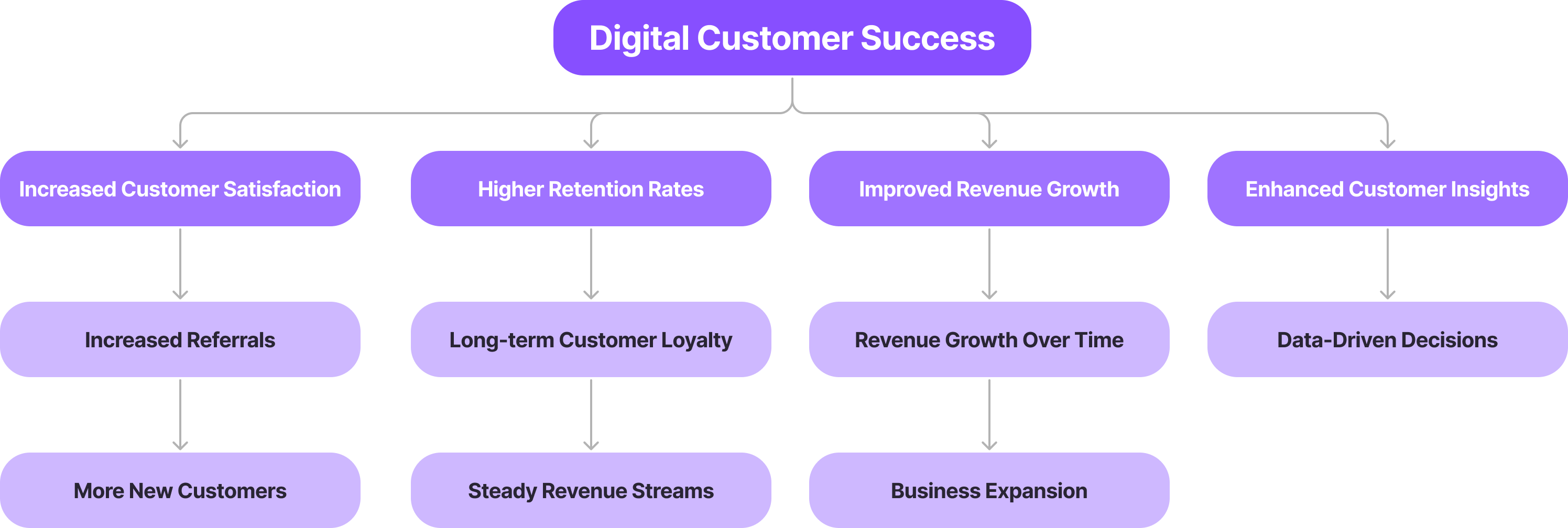
Digital customer success refers to a tech-driven, AI-enhanced approach to guiding customers toward their desired outcomes—using automated, low-touch, or fully self-serve interactions at scale. But in 2026, the definition has expanded. It's no longer just about replacing high-touch engagement with automation. It's about building intelligent systems that understand customer context, detect signals, and take action autonomously. At its core, this means deploying an AI-powered digital customer success platform that serves as the operating layer for every post-sale interaction.
The global Customer Success Platforms market is projected to reach $9.17 billion by 2032, growing at a 22.1% CAGR—a clear sign that this discipline has moved from "nice-to-have" to mission-critical infrastructure. Meanwhile, 72% of CS leaders believe AI will be critical to their operations by year-end, yet only a fraction have deployed live use cases. The gap between intent and execution is where the biggest opportunity lies.
For a concise definition, see our Digital Customer Success Glossary Entry.
The Big Shift: From Relationship Owners to Outcome Architects
The most significant transformation in 2026 isn't a new tool or framework—it's a mindset change. CSMs are moving from being relationship owners to becoming outcome architects. Instead of measuring success by how many check-in calls happened or how responsive a CSM was, leading organizations are measuring whether customers actually achieved the business results they signed up for.
This shift has several implications. First, customer journeys are now centered on prescriptive, measurable outcomes—not just feature adoption milestones. Second, value demonstration has moved from an annual QBR exercise to an always-on capability, with dynamic dashboards and AI-generated ROI stories replacing static slide decks. Third, CS teams are being held accountable for top-line and bottom-line results, not just retention.
Learn how top companies are making this transition in our article, From High Touch to Scalable Success: Embracing Digital Touchpoints.

AI Agents: The New Backbone of Digital CS
If 2025 was the year CS teams experimented with AI, 2026 is the year AI became embedded in the operating model. The conversation has shifted from "should we use AI?" to "how deeply is AI woven into our workflows?"
The most impactful development is the rise of agentic AI—autonomous agents that don't just surface insights but actually take action. These agents detect real signals (a stalled onboarding task, a frustrated survey response, declining product usage) and respond instantly: updating CRM fields, triggering personalized nudges in the customer hub, posting alerts in Slack, or escalating to a human CSM when the situation calls for it.
This is fundamentally different from the chatbots and automation rules of previous years. AI agents are goal-driven, context-aware, and deeply integrated with your data sources. They understand where a customer is in their journey and what action will move them forward.
The result? CSM-to-customer ratios are changing. Staffing models are shifting. And the 30–40% of a CSM's time that used to go toward administrative tasks—rewriting notes, manually following up, hunting for product gaps—is being reclaimed for strategic work.
Curious about how this works in practice? Explore AI Agents for Post-Sale Journeys to see how teams are deploying agents that handle onboarding touchpoints, detect churn risk, and drive expansion—all without manual intervention.
Segmentation Gets Smarter
Segmentation has always been the foundation of effective digital CS, but in 2026, static segments are giving way to dynamic, AI-informed cohorts. Instead of grouping customers by ARR tier or geography alone, leading teams are factoring in real-time behavioral data: product usage patterns, engagement velocity, time-to-milestone achievement, and sentiment signals from support interactions.
This evolution means your digital programs can adapt in real time. A customer who's blazing through onboarding milestones gets accelerated to adoption content. One who's gone quiet gets a proactive outreach sequence. The segmentation isn't just about who gets what message—it's about dynamically adjusting the entire journey based on where each customer actually is, not where your playbook assumes they should be.
This kind of intelligent segmentation allows you to:
- Deliver hyper-relevant content: Surface the right resource, at the right moment, based on the customer's actual context—not a generic persona.
- Automate without losing the human feel: When each segment receives messaging aligned with their real behavior and goals, digital outreach feels personal, not robotic.
- Optimize your team's focus: CSMs concentrate on high-complexity or high-risk accounts while AI handles the rest—without those customers feeling neglected.
- Scale thoughtfully: Micro-personalization for every segment, even as your customer base doubles or triples.
Digital Onboarding: Where Speed Meets Personalization
The first 90 days still make or break a customer relationship, but the bar for onboarding has risen dramatically. In 2026, customers expect to reach their first meaningful outcome fast—often within the first week—and they expect the onboarding experience to feel tailored to their specific use case, not a one-size-fits-all walkthrough.
The best digital onboarding frameworks in 2026 combine several elements: AI-guided task sequences that adapt based on customer progress, self-serve knowledge resources surfaced contextually (not buried in a help center), collaborative workspaces where customers and CSMs can align on goals and track milestones together, and automated triggers that keep momentum going even when no one is watching.
{{master-customer-engagement}}
Why Digital Onboarding Matters More Than Ever
- Faster Time to Value: AI-guided onboarding paths get customers to their first "aha" moment without manual hand-holding. Leading teams are seeing 50% faster time-to-value with the right infrastructure in place.
- Scalable Consistency: Every customer gets a best-practice onboarding experience, regardless of their account tier or which CSM they're assigned to.
- Reduced Support Load: When onboarding is self-serve and intelligent, your support queue shrinks and your CSMs can focus on strategic conversations.
For a more extensive look at digital-touch onboarding strategies, check out our page on How to Launch a Digital Onboarding Program.
The Right Tech Stack: CSP + Customer-Facing Interface
In 2026, the tech stack conversation has matured. It's now clear that you need two complementary layers: a Customer Success Platform (CSP) to manage your internal CS processes and health scoring, and a customer-facing interface to deliver the actual digital experience your customers interact with.
The CSP handles the "back office"—health scores, risk alerts, playbook triggers, team workflows. The customer-facing layer handles the "front office"—personalized hubs, collaborative workspaces, task management, knowledge surfacing, and AI-powered guidance. When these two layers work together, you get a complete picture: internal intelligence driving external experience.
This is also where ecosystem integrations become critical. Standalone SaaS products that don't connect to a customer's broader tech stack are losing ground. The winning approach is deep integration—pulling data from CRMs, support tools, product analytics, and conversation intelligence platforms to create a unified view of each customer's journey.
For a detailed look at how this works in practice, see How to Overcome Digital CS Challenges Using Gainsight and EverAfter.

AI-Powered Personalization at Scale
Personalization in 2026 goes far beyond inserting a customer's name into an email. Today's AI-native platforms can generate entire customer interfaces—personalized to each account's package, persona, usage history, and goals—without writing a single line of code. The AI analyzes customer data in real time and surfaces the most relevant next actions, content, and recommendations for each individual user.
This is the promise that digital CS has been building toward: truly personalized experiences, delivered at scale, without requiring an army of CSMs to maintain them. AI Experts—always-on knowledge assistants embedded directly in the customer experience—can answer questions, provide guidance, and point customers to the right resources 24/7, trained on your company's specific knowledge base and product documentation.
Curious about creating custom user portals quickly? Check out the AI-Native Interface Builder and AI Studio to see how teams are building branded post-sale experiences in minutes.
Metrics That Matter in 2026
The metrics landscape has shifted, too. While adoption rates and NPS scores still have their place, the metrics that CS leaders are now held accountable for look much more like business outcomes: Net Revenue Retention (NRR), Gross Revenue Retention (GRR), expansion revenue, and time-to-value. In fact, 93.7% of companies that measure CS impact now use a revenue target as their primary metric.
The expectation from the board is clear: CS must directly contribute to top-line and bottom-line results. That means tracking not just whether customers are "healthy," but whether they're actually achieving the outcomes they paid for—and whether those outcomes translate into renewals, expansions, and advocacy.
See our Digital Customer Success Tracking Scorecard to understand which metrics matter most.
{{cta-demo2}}
Key KPIs to Watch
- Time to First Value (TTFV): How quickly do new customers reach a meaningful outcome? This is now the #1 leading indicator of long-term retention.
- Outcome Achievement Rate: Are customers reaching the specific business outcomes they defined at kickoff?
- Digital Engagement Quality: Not just "did they open the email" but "did they complete the task, watch the tutorial, and progress to the next milestone?"
- Expansion Revenue Influenced by CS: Track how digital programs contribute to upsell and cross-sell pipeline. CS-driven expansion has grown from 10% to nearly 50% over the past decade.
- Customer Effort Score: How easy is it for customers to get what they need without contacting support?
Continuous Optimization: The Feedback Loop
The best digital CS programs in 2026 aren't static—they're learning systems. AI enables a continuous feedback loop where customer behavior data flows back into your programs, automatically refining what works and flagging what doesn't.
Steps to Ongoing Optimization
- Baseline & Benchmark: Record initial KPIs and set outcome-based targets for each customer segment.
- Analyze & Diagnose: Use AI to surface patterns in usage data—where are customers stalling, dropping off, or accelerating?
- Experiment & Refine: A/B test onboarding sequences, content recommendations, and agent-driven interventions. Let the data decide, not assumptions.
- Communicate & Align: Present findings to stakeholders with dynamic dashboards and co-authored value stories—not static QBR decks.
Check Out: Our Measuring Digital CS Effectiveness Guide offers a step-by-step blueprint for continual improvement.
Your 2026 Digital CS Roadmap
By now, the picture should be clear: digital customer success in 2026 is not about doing more—it's about doing smarter. It's about building an intelligent, outcome-driven ecosystem where AI handles the heavy lifting, customers move forward autonomously, and your team focuses on the strategic work that actually moves the needle.
Here's how to put it all together:
- Accept that digital CS is no longer optional. Customer expectations have surpassed what any high-touch model can deliver alone. The companies winning in 2026 have fully embraced digital-first strategies.
- Shift from relationship management to outcome architecture. Measure success by whether customers achieved their business goals, not by how many touchpoints you delivered.
- Deploy AI agents, not just AI features. Move beyond chatbots and copilots to autonomous agents that detect signals and take action in real time.
- Build a two-layer tech stack. Pair your internal CSP with a customer-facing interface that delivers personalized, data-driven experiences at scale.
- Invest in smart segmentation. Use real-time behavioral data to dynamically adjust journeys, not static segments based on ARR or geography.
- Track business outcomes, not vanity metrics. Align your KPIs with revenue impact—NRR, GRR, expansion pipeline, and time-to-value.
- Never stop iterating. Use AI-powered feedback loops to continuously refine your programs based on what's actually working.
The organizations that thrive in 2026 and beyond won't be the ones with the biggest CS teams. They'll be the ones with the smartest digital infrastructure—where every customer interaction is purposeful, every journey is adaptive, and every outcome is measurable.

.png)

.png)


%20(1).png)


.png)
.png)
.png)


.avif)



.png)
.png)


