





- AI is replacing manual CS work
- Technical CS is becoming essential
- Post-sale strategy is fragmented in most SaaS companies
- New metrics are required to measure real outcomes
Customer Success used to be built around a simple idea: assign humans to accounts, run QBRs, monitor health scores, chase renewals, and escalate when something breaks.
That model is no longer enough.
AI has changed what customers expect after the sale. They do not want another portal, another ticket, another “we’ll get back to you,” or another generic success plan. They want faster answers, clearer outcomes, technical guidance, proactive value, and proof that your company understands their business.
This is the new post-sale reality: Customer Success is no longer a relationship function. It is becoming an AI-powered growth system.
Gartner’s recent research shows just how urgent this shift has become. In a 2026 survey, 91% of customer service and support leaders reported pressure from executive leadership to implement AI, with leaders prioritizing customer satisfaction, operational efficiency, and self-service success. Gartner also found that nearly 80% of organizations plan to transition at least some agents into new roles as routine tasks become automated.
That last point matters. AI is not simply replacing humans. It is forcing companies to redefine what humans are for.
And in Customer Success, that means one thing: the old CS playbook is breaking.
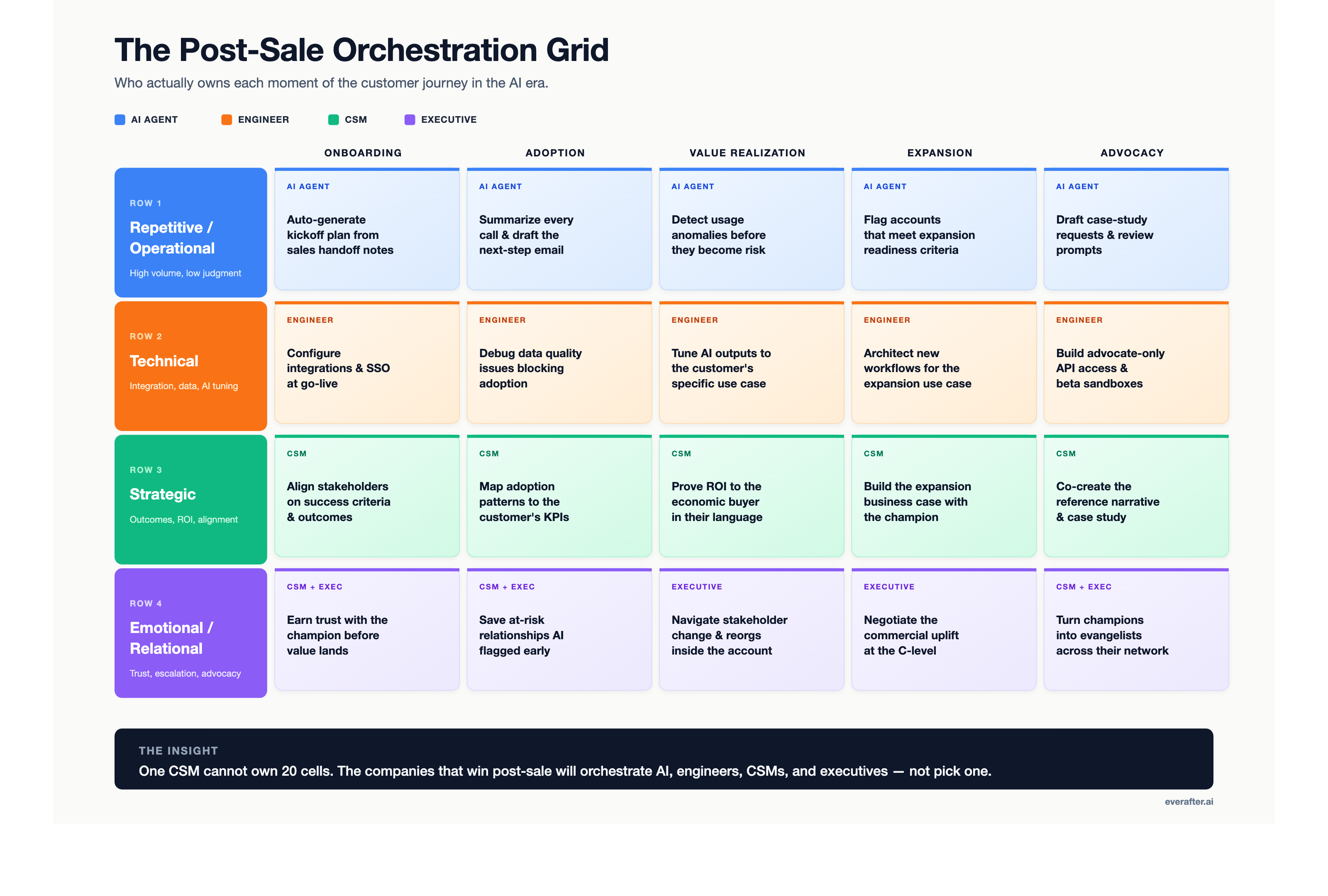
1. Rebuilding CS for AI: From Account Management to Outcome Engineering
The most important question for CS leaders today is not, “How do we add AI to our current process?”
It is: “What would Customer Success look like if we designed it from scratch for the AI era?”
The answer is very different from the traditional model.
In the old model, CS teams were reactive. They checked in after onboarding. They reviewed usage dashboards. They waited for support tickets, renewal risk, or executive escalation. Even “proactive CS” often meant sending automated emails when usage dropped.
In the AI era, that is too slow.
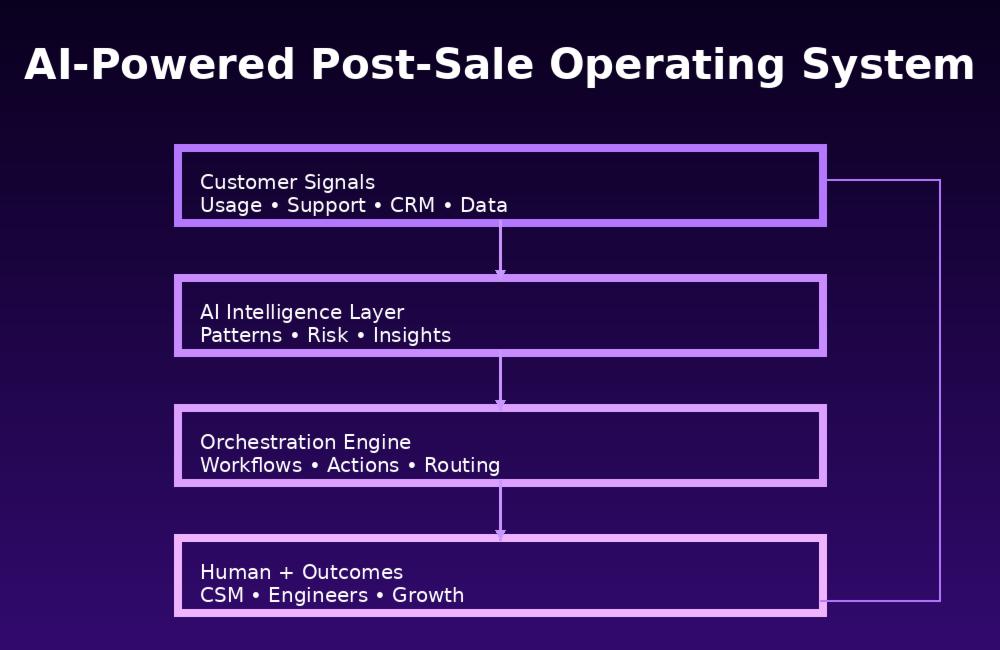
Modern CS needs to become a real-time customer intelligence layer powered by orchestrated customer journeys. It should know which customers are stuck, which teams are under-adopting, which use cases are expanding, which champions are disengaging, which accounts are technically blocked, and which outcomes are not being achieved.
AI makes this possible, but only if CS is rebuilt around data, workflows, and action.
Gartner identifies four high-value AI areas in service and support: agent enablement, customer self-service, operational support automation, and agentic AI across the stack. These are not just support use cases. They are the foundation of the next CS operating model.
The future CS organization will likely have fewer people doing manual follow-up and more people orchestrating outcomes. Instead of asking CSMs to remember every risk signal, summarize every call, write every follow-up, and manually coordinate every stakeholder, AI will handle the repetitive work.
That gives humans room to do what AI cannot fully own: judgment, strategy, empathy, executive alignment, commercial nuance, and complex problem-solving.
But this shift requires a new structure.
CS teams will need people who can manage AI workflows, improve knowledge systems, design lifecycle journeys, interpret product telemetry, and translate customer intent into action. Gartner found that 58% of service leaders aim to upskill agents into knowledge management specialists because AI and self-service depend on accurate, continuously updated content.
That insight should hit every CS leader hard.
Your AI is only as good as your post-sale knowledge.
If your onboarding content is outdated, your help center is fragmented, your CSM notes are trapped in free text, your customer goals are not structured, and your implementation learnings are scattered across Slack, your AI will not magically create a better customer experience.
It will scale the mess.
Rebuilding CS for AI starts with rebuilding the knowledge, data, and workflow foundation underneath CS.
2. Why Customers Need Engineers: The Rise of Technical Customer Success
One of the strongest signals in the agenda is this: customers increasingly need engineers.
Not more “touchpoints.” Not more status meetings. Not more polished decks.
Engineers.
Why? Because AI products, APIs, automation platforms, data workflows, and technical B2B tools are no longer simple “log in and use it” products. They need integration, configuration, experimentation, and continuous optimization.
Customers are buying outcomes, but many of those outcomes depend on technical execution.
That creates a major gap in traditional CS.
The CSM may understand the relationship. The support team may resolve tickets. The sales engineer may disappear after the deal closes. Product may be too far removed from the customer’s day-to-day implementation reality.
So the customer is left asking: “Who can actually help us make this work?”
This is why technical CS is becoming central to post-sale growth.
In the AI era, the best post-sale teams will combine relationship ownership with engineering capability. They will not wait for customers to file tickets. They will help customers design workflows, debug implementation issues, improve data quality, test AI outputs, evaluate use cases, and move from adoption to measurable value.
This is especially true when AI is embedded into the product. Gartner predicts service and support will move upstream, with teams focusing more on product usage, adoption, and revenue growth instead of only managing reactive requests.
That is exactly where technical CS becomes powerful.
A technical customer success motion can help answer questions like:
- What is blocking time-to-value?
- Which integrations are incomplete?
- Where is customer data preventing AI from working well?
- Which workflows are creating friction?
- Which use cases should be automated first?
- What does “good output” actually mean for this customer?
- How do we prove ROI inside the customer’s business?
These are not generic relationship questions. They are operational and technical questions.
The companies that win will not just give customers a CSM. They will give them a post-sale team that can actually engineer success.
3. Exposing Broken Post-Sale Strategy: The Hidden Revenue Leak
Most companies claim to care about post-sale.
But their org chart tells the truth.
Sales gets the best tools, the cleanest process, the most executive attention, and the clearest revenue targets. Marketing owns acquisition. Product owns roadmap. CS owns “retention,” but often without enough authority over onboarding, adoption, value realization, support, education, expansion, or customer marketing.
That is not a strategy. That is a handoff problem disguised as a function.
Forrester has been clear that post-sale engagement is essential for B2B companies to retain customers, grow accounts, and create advocates. Its Postsale Customer Lifecycle Framework emphasizes alignment from onboarding through product usage, renewal, expansion, and advocacy.
The problem is that many companies still treat post-sale as a department instead of a lifecycle.
That creates broken moments everywhere:
- The buyer hears one promise during sales, but onboarding delivers another reality.
- The customer has a strategic goal, but CS tracks only usage.
- Support sees recurring issues, but Product never gets the full pattern.
- Expansion is triggered by renewal timing, not value readiness.
- Customer marketing asks for advocacy before the customer has achieved success.
- Leadership wants NRR growth, but the customer experience is fragmented.
This is why post-sale strategy breaks.
It is not because CSMs are not working hard. It is because the system around them is not designed for customer outcomes.
Forrester reported that customer-obsessed organizations outperform peers, including faster revenue growth and stronger retention. In one Forrester source, customer-obsessed organizations reported 41% faster revenue growth, 49% faster profit growth, and 51% better customer retention than non-customer-obsessed organizations.
That is the commercial argument for fixing post-sale.
Customer obsession is not soft. It is a growth architecture.
A strong post-sale strategy should define:
- Who owns customer outcomes?
- How is value promised, delivered, measured, and expanded?
- Where does AI automate the journey?
- Where do humans intervene?
- Where do engineers engage?
- Which customer signals trigger action?
- How does the company turn customer learning into product, marketing, and revenue decisions?
Without this clarity, AI will not save post-sale. It may simply automate broken processes faster.
4. The Seven Metrics for the AI Era
The AI era requires a new measurement system.
Traditional CS metrics still matter: NRR, GRR, churn, adoption, CSAT, NPS, and expansion. SaaStr’s 2025 CS metrics discussion highlights how investors still care deeply about Net Revenue Retention and Gross Revenue Retention, with top-quartile SaaS companies reaching 120%+ NRR.
But AI introduces new questions.
- Are customers getting value faster?
- Are humans spending time on the right accounts?
- Is AI improving resolution or just deflecting work?
- Are customer journeys becoming more personalized?
- Are technical blockers being solved earlier?
- Is post-sale creating expansion-ready customers?
Here are seven metrics every CS leader should consider for the AI era.
1. Time to First Value
How quickly does a customer experience a meaningful result after purchase?
In AI-driven CS, speed matters. Customers will not tolerate long onboarding cycles if AI can guide setup, summarize next steps, personalize enablement, and detect blockers early. Companies like Salesloft have proven this is possible at scale.
2. Outcome Attainment Rate
What percentage of customers achieve the business outcome they bought your product for?
This is more powerful than usage alone. A customer can log in often and still fail to achieve value.
3. AI Resolution Quality
Do AI-powered interactions actually solve the customer’s issue?
This should include accuracy, escalation quality, customer effort, and whether the customer needed to reopen the issue.
4. Human Escalation Value
When humans get involved, are they handling high-value work?
AI should free humans to solve complex, strategic, emotional, or commercially important issues. If humans are still stuck answering repetitive questions, the system is underperforming.
5. Technical Blocker Velocity
How fast does your team identify and remove implementation, integration, data, or workflow blockers?
This is critical for products where adoption depends on technical success.
6. Expansion Readiness
Which accounts have achieved enough value, maturity, and stakeholder alignment to be ready for expansion?
Expansion should be based on proven value, not just contract timing.
7. Customer Knowledge Health
How complete, current, and usable is your customer knowledge base?
This includes internal notes, onboarding content, product documentation, use-case libraries, support patterns, and AI training material. In the AI era, knowledge quality becomes a growth metric.
5. The New CS Mandate: Less Manual Coordination, More Customer Orchestration
The future of Customer Success is not “more automation” by itself.
It is orchestration.
AI can summarize calls, detect risk, personalize journeys, recommend next actions, power self-service, and automate operational work. But the company still needs a strategy for when AI acts, when humans step in, when engineers engage, and how every motion connects to customer value.
Gartner’s 2025 research notes that AI will transform customer service through inbound automation, proactive issue prevention, and operational efficiency. It also says service leaders must shift from people management to AI leadership while still developing human talent.
That is the right framing for CS too.
The CS leader of the future is not only a people leader. They are an operating-system designer.
They must design how customers move from purchase to onboarding, from onboarding to adoption, from adoption to value, from value to expansion, and from expansion to advocacy.
They must decide which moments are automated, which are human-led, which require technical expertise, and which should trigger executive engagement.
They must connect Product, Support, Sales, Marketing, RevOps, and Customer Education into one post-sale motion.
And they must prove that post-sale is not a cost center.
It is where durable growth happens.
Common Customer Success Mistakes in the AI Era
- Treating AI as a tool, not a system
- Measuring activity instead of outcomes
- Ignoring technical blockers
- Fragmenting post-sale ownership
What to Do Next
- Audit your post-sale journey
- Identify where AI replaces manual work
- Define outcome-based metrics
- Introduce technical CS roles
- Book a demo with EverAfter
FAQ
What is AI in Customer Success?
AI in Customer Success refers to using machine learning, generative AI, and automation to handle work that CS teams used to do manually—such as summarizing calls, detecting churn risk, personalizing onboarding, powering self-service, and recommending next-best actions—so humans can focus on strategy, judgment, and complex customer outcomes.
How does AI improve customer retention?
AI improves retention by surfacing risk signals earlier, accelerating time-to-value, personalizing customer journeys, removing technical blockers faster, and ensuring CSMs spend their time on the highest-impact accounts instead of repetitive coordination work.
What metrics matter in Customer Success today?
Beyond NRR, GRR, and CSAT, the AI era introduces new metrics: Time to First Value, Outcome Attainment Rate, AI Resolution Quality, Human Escalation Value, Technical Blocker Velocity, Expansion Readiness, and Customer Knowledge Health.
Why is technical Customer Success important?
Modern B2B and AI products require integration, configuration, and continuous optimization to deliver value. Technical CS combines relationship ownership with engineering capability so customers can actually achieve the outcomes they bought—rather than getting stuck on implementation or data issues.
Conclusion: AI Will Not Fix Customer Success. It Will Expose It.
AI is not a magic layer you add to an outdated CS model.
It is a stress test.
It will expose weak onboarding. It will expose poor documentation. It will expose vague ownership. It will expose shallow health scores. It will expose broken handoffs. It will expose companies that talk about outcomes but manage only renewals.
But for companies willing to rebuild, AI is also the biggest opportunity CS has had in years.
It can remove low-value work. It can make customer journeys more personal. It can surface risk earlier. It can help engineers and CSMs act faster. It can turn fragmented post-sale activity into a coordinated growth engine.
The next generation of Customer Success will not be defined by how many accounts each CSM manages. It will be defined by how intelligently the company can orchestrate customer outcomes at scale.
That is the real AI-era CS playbook.
And the companies that build it first will not just retain more customers. They will become much harder to replace.

.png)

.png)


%20(1).png)


.png)
.png)
.png)


.avif)




.png)
.png)
.png)


