



.png)

TL;DR: Customer Success teams no longer need to choose between automation and human relationships. The most effective organizations use the Empathy Algorithm: AI handles data, pattern detection, and routine engagement, while human CSMs focus on strategy, emotional intelligence, and executive alignment. EverAfter AI makes this balance scalable by unifying data, automating personalized success plans, enabling transparent shared health scores, and surfacing expansion opportunities. The result: infinitely scalable CS operations that remain deeply human.
In the current high-value B2B landscape, Customer Success organizations face a fundamental, existential paradox. On one hand, the demands of a scalable, global business mandate the use of Artificial Intelligence (AI) and automation to handle volume, drive efficiency, and manage data. On the other, the retention of high-value accounts, the foundation of profitable growth, depends entirely on deep personalization, strategic guidance, and genuine empathy, qualities that are inherently human. The prevailing fear of AI is not that it will replace the CSM, but that it will introduce customer alienation. In an age where digital interaction is the norm, the ultimate luxury is a true relationship. Customers do not want to feel like a metric being processed by a cold, efficient machine; they want a proactive partner who understands their nuanced business goals.
{{cta-demo2}}
The most successful Customer Success teams are moving past this binary choice. They are not asking, "AI or Human?" They are mastering the Human-AI Balance to establish what we call the Empathy Algorithm. This framework dictates that AI and automation must be strategically employed to augment the human Customer Success Manager (CSM), freeing them from the mundane to focus entirely on strategy, relationship-building, and value realization. The result is a CS function that is both infinitely scalable and profoundly personal.
The Problem: Where Automation Fails Empathy and Value

When implemented without strategic foresight, pure automation creates friction at the very moments a customer needs trust the most. This misalignment leads to three critical failure points:
1. The "Black Box" Effect and Lack of Transparency
A traditional, automated health score aggregates data points behind the scenes, a spike in support tickets, a drop in product usage, and flags the customer as "Red." While efficient, this approach is a "black box" to the customer. They receive a generic alert, but lack the context to understand why they are "unhealthy" and what specific actions to take.
The Customer Experience: The customer sees a confusing status, feels penalized by an opaque system, and ultimately becomes frustrated. They are served by a system they can't trust, which damages accountability and undermines the partnership's strategic nature.
The CSM's Burden: The CSM is forced into a defensive posture, spending the first 15 minutes of an urgent call deciphering the health score's inputs instead of discussing solutions, further eroding the strategic value they are meant to deliver.
2. The Critical Moment Misfire: Ambiguity and Emotion
AI excels at routine tasks with clear parameters. However, in high-stakes, ambiguous situations, automation fails spectacularly because it lacks emotional intelligence and strategic nuance. These moments are often the most critical inflection points in a customer lifecycle:
Renewal Negotiations: A renewal is not a transaction; it is a strategic business decision. It requires a human CSM who can leverage relationship history, executive influence, and subtle compromise. Automated, price-driven prompts or generic feature upsells at this stage feel tone-deaf and threaten the entire partnership.
Major Escalations and Outages: When a mission-critical service is down, the customer needs a human champion, a reliable, empathetic individual who can coordinate resources, absorb frustration, and communicate clearly under duress. An automated, tiered support system only adds to the anxiety, highlighting the cold nature of the relationship instead of its collaborative strength.
3. Data Overload and Strategic Paralysis for the CSM
The irony of modern CS technology is that it often makes the human job harder, not easier. CSMs are constantly pulling, cleaning, and validating data across five different systems, CRM, usage logs, finance, support tickets, and email archives.
The Efficiency Trap: The CSM spends hours generating a Quarterly Business Review (QBR) deck, leaving little time for the high-value activities the QBR is meant to facilitate: strategy, alignment, and relationship-building.
Reduced Empathy Capacity: When a human's cognitive load is consumed by administrative work and data wrangling, their capacity for strategic thought and genuine empathy is diminished. They become reactive administrators rather than proactive partners, losing sight of the customer's true needs.
The Solution: Defining Roles for Scaled Empathy
The Empathy Algorithm demands that the CSM and AI operate in clearly defined lanes of expertise. The relationship must be structured so that AI handles the "how" and the "what" of execution, while the CSM handles the "why" and the "who" of strategy.
.jpeg)
A. The AI's Role: The Engine of Efficiency and Insight
The primary function of AI is to be the perfect wingman, the ultimate preparation engine that ensures the CSM never enters a conversation cold, overwhelmed, or focused on the wrong priority.
Intelligent Data Aggregation and Normalization: AI must consolidate all disparate customer data, product usage, support sentiment, financial health, and communication history, into a single, unified, and predictive health score. This is more than a simple metric; it's a predictive model that isolates the root cause of risk or opportunity, instantly saving the CSM hours of manual reporting.
Early Warning and Predictive Modeling: AI identifies subtle behavioral shifts, a change in which key executives log in, a quiet drop in usage of a mission-critical feature, and flags the account as trending toward risk or ready for expansion, often weeks before any visible alarm. This allows for proactive intervention rather than reactive damage control.
Routine Engagement and Personalization at Scale: AI manages low-priority touchpoints, such as automated follow-ups after training, personalized resource sharing based on the customer's current success plan stage, and managing low-touch segments. This frees up the human CSM's calendar for high-value strategic time.
B. The CSM's Role: The Architect of Value and Relationship
Freed from administrative burdens and equipped with precise, AI-generated context, the human CSM can finally dedicate their time to their highest-value functions:
Strategic Value Realization: The CSM focuses exclusively on the customer's stated business outcomes. Their conversations shift from, "How are you using the product?" to, "How is the product helping you achieve your $X revenue goal?" They become a true consultant, driving adoption and ensuring maximum ROI from the partnership.
Executive Alignment and Advocacy: The CSM leads all executive-level communication, using AI-generated data to conduct highly compelling and concise QBRs. They build strong, trusting C-suite relationships, acting as the internal champion for the customer's long-term success.
Complex Issue Navigation: They apply human empathy, emotional intelligence, and strategic thinking to navigate ambiguity, overcome internal hurdles, and handle critical escalations, reinforcing the strength and reliability of the human partnership.
Introducing EverAfter AI: The Single Platform for Scaled Success
The challenge with the Human-AI Balance is often the technology stack itself. Most solutions offer fractured tools, one for data, one for automation, one for communication. EverAfter AI was built to solve this integration challenge, acting as the single digital bridge between your scale needs and your customer's desire for personal value. It is an AI-powered digital customer success platform that orchestrates every stage of the customer lifecycle—from onboarding through renewal—inside one unified, customer-facing environment.
EverAfter AI is a unified Customer Success platform that orchestrates the entire customer journey, from onboarding to renewal, by seamlessly connecting internal data, CSM workflows, and, most importantly, the customer experience itself.
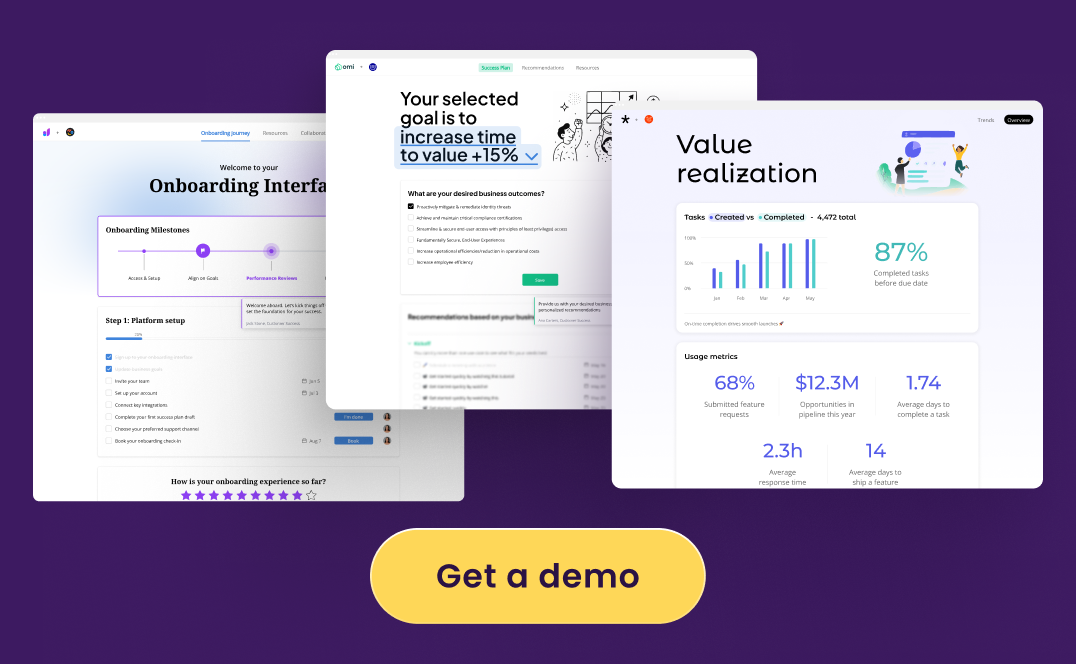
Our core function is to empower CSMs to manage an infinite number of personalized customer programs at scale through our AI-driven Customer Interface. We move beyond simple portals to create a dynamic, two-way communication channel where value is constantly exchanged and clearly visible.
The Customer Interface: Managing Infinite Programs at Scale
The EverAfter Customer Interface is not just a dashboard; it is the personalized, dynamic environment that makes the Empathy Algorithm a reality. It fundamentally changes how CS operates, moving from static, one-size-fits-all processes to infinite, hyper-personalized journeys.
{{cta-demo2}}
1. Dynamic Success Plans and Personalized Journeys
Traditional CS relies on a handful of static playbooks. EverAfter AI uses AI to generate dynamic, personalized Success Plans for every customer.
Infinite Programs: The AI automatically enrolls customers into hyper-specific, micro-programs based on their industry, tech stack, maturity level, and stated goals. If a customer is a "FinTech startup targeting EU expansion," the AI spins up a compliance-focused program. If another is a "Mid-Market B2B SaaS focused on retention," the AI initiates a feature adoption program. This scale is impossible for humans to manage manually.
Personalized Content Delivery: The interface delivers specific, AI-curated content (training videos, best practice guides, feature announcements) only when and where it is relevant to the customer's immediate stage in their success plan, maximizing engagement and time-to-value.
2. Context-Rich Hand-offs: The CSM's Safety Net
When a personal touch is needed, the hand-off is seamless and informed.
AI-Summarized Account State: If a customer opens a high-priority ticket through the interface, the AI instantly provides the human CSM with an objective summary of the last three critical events, recent usage trends, and the customer's current sentiment score.
Proactive Conversation Outlines: The AI doesn't just pass a flame; it passes a torch. It suggests personalized, human-friendly communication outlines directly in the CSM's workflow, ensuring the human's response is highly contextual, empathetic, and strategic, rather than boilerplate.
3. Full Transparency and Shared Accountability
The interface solves the "Black Box" problem by making the health score a shared accountability metric.
Visible Health Drivers: The customer can see exactly what factors are driving their health score, adoption of key features, completion of onboarding milestones, or engagement with the success plan. This empowers them to take ownership of their own outcomes.
Shared Success Plans: The CSM and the customer co-manage the Success Plan directly within the interface, transforming a static document into a live, collaborative project timeline with clear milestones and accountability metrics for both parties.
4. Automated Expansion Opportunity Identification
By constantly monitoring usage data against industry benchmarks and established Value Realization Scores, the AI identifies optimal moments for expansion.
The interface might flag a customer in the 'Scale-Up' program who has maximized usage of Feature A, and instantly presents the CSM with a recommendation to discuss Feature B, along with a draft email highlighting the specific ROI the customer can expect.
Conclusion: The Future is Scaled Empathy
The goal of the Empathy Algorithm is not to make CS teams efficient; it is to make them infinitely effective and undeniably strategic. By using EverAfter AI, you stop managing accounts based on static segments and start managing infinite, personalized customer programs that scale with the power of AI.
The result is a CS function that delivers a consistently high-touch, relationship-focused experience to every customer, every time. You retain the strategic, empathetic power of your CSMs while multiplying their capacity a thousandfold. The final takeaway is clear: Your AI should never speak for your CSM, but it must always prepare your CSM to speak better and more strategically. See how leading companies like AppsFlyer, Salesloft, and Okta are already implementing this approach. Next Step: Are you ready to empower your CSMs to be relationship architects instead of data processors? Book a demo to start implementing the Empathy Algorithm and scaling personalized value today.

.png)

.png)


%20(1).png)


.png)
.png)
.png)


.avif)



.png)
.png)


