



.png)

Vibe Coding is a framework that merges brand identity, real-time data, and intelligent design to create intentional customer experiences. As Customer Success becomes the last frontier for brand experience, companies that master Vibe Coding will transform CS from a cost center into a growth engine. EverAfter AI Studio is the first true Vibe Coding environment for CS, where design, data, and brand converge to build unparalleled customer loyalty.
For decades, the strategic engine of any growth company has relied on two key pillars of digital experience: Product and Marketing. Both have undergone profound transformations, moving from simple functionality to sophisticated emotional engagement. Yet, one critical function has lagged behind: Customer Success (CS).
Customer Success is about to undergo the same kind of disruptive transformation that revolutionized product design with tools like Figma and marketing automation with platforms like Webflow. The world of post-sale experience is definitively shifting from a reactive function defined by reporting and retention to a proactive strategy built on relationship and resonance.
The next era of Customer Success will not be defined by how much data teams collect, but by how that data feels when experienced by the customer. This is the premise of Vibe Coding, a framework that merges brand identity, real-time data, and intelligent design to create intentional customer experiences, and it is the direction the post-sale relationship is heading, fast.
The Evolution of Digital Experience: From Function to Emotion
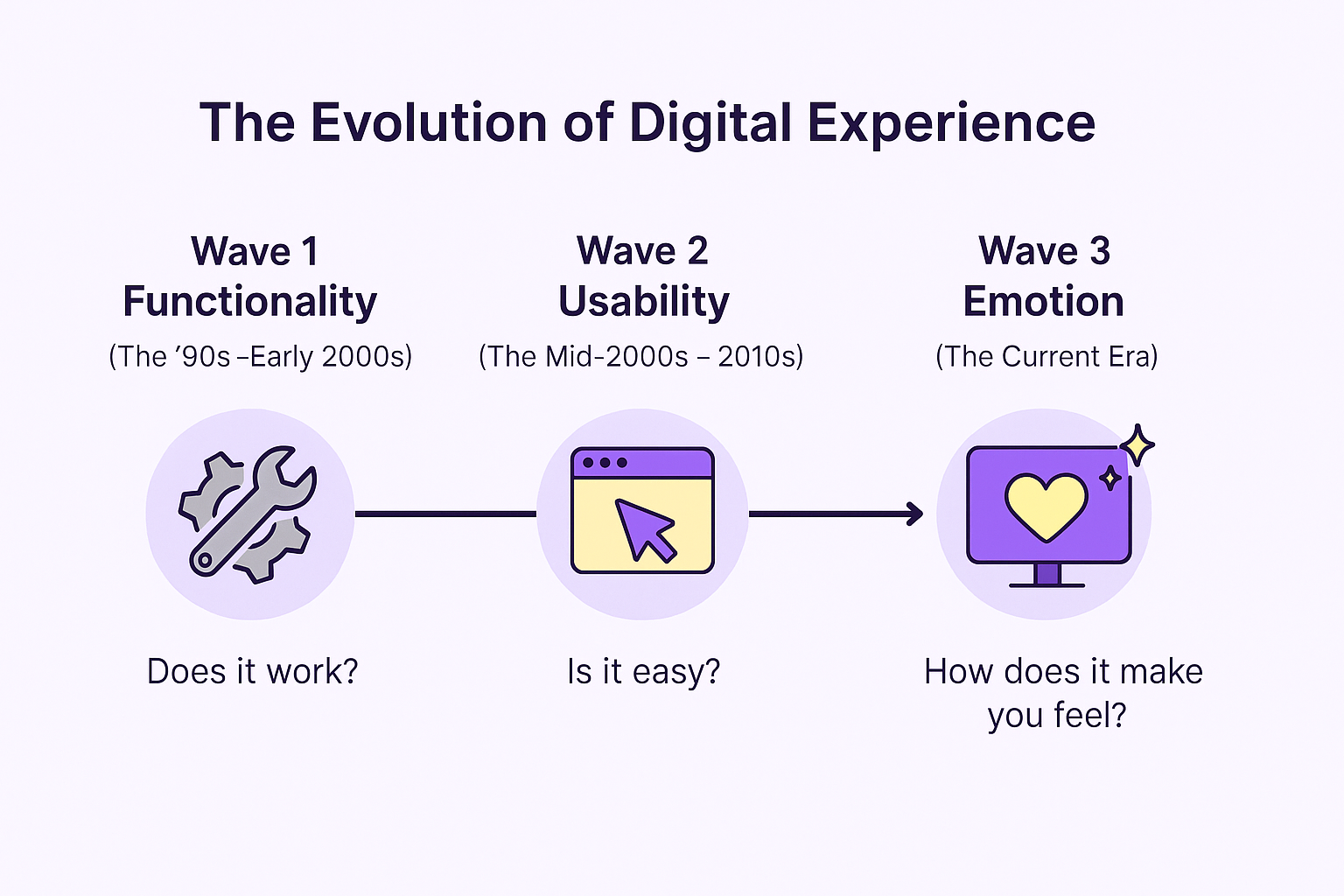
To understand why Vibe Coding is necessary, we must contextualize the evolution of digital interaction across the business lifecycle:
Wave 1: Functionality (The 90s - Early 2000s)
Digital tools were built purely to solve a problem. The user experience was secondary. Success was measured solely by whether the tool worked.
Wave 2: Usability (The Mid-2000s - 2010s)
The focus shifted to efficiency. Tools needed to be intuitive, clear, and easy to navigate. Success was defined by low friction and time-to-completion.
Wave 3: Emotion and Identity (The Current Era)
We have entered the era of emotion. Customers now demand experiences that not only work efficiently but also express brand personality, build subconscious trust, and adapt dynamically to their needs. This requires design consistency, a unique brand voice, and tonal alignment across every digital touchpoint.
Marketing teams leverage CMS platforms to ensure their digital identity is consistent. Product teams use design systems to guarantee features feel cohesive. But when the customer signs the contract and moves into the Customer Success phase, they are often handed off to a static, white-labeled dashboard or a generic portal that strips the brand out entirely. This sudden tonal and visual dissonance breaks the emotional connection the company worked so hard to build.
It is time for the post-sale experience to catch up to the brand promise.
What Vibe Coding Really Means for Customer Success
Vibe coding is not merely about decorating an interface or setting a "mood." It is a foundational framework for designing and coding experiences that dynamically behave like your brand, powered by a live stream of data and intelligent systems.
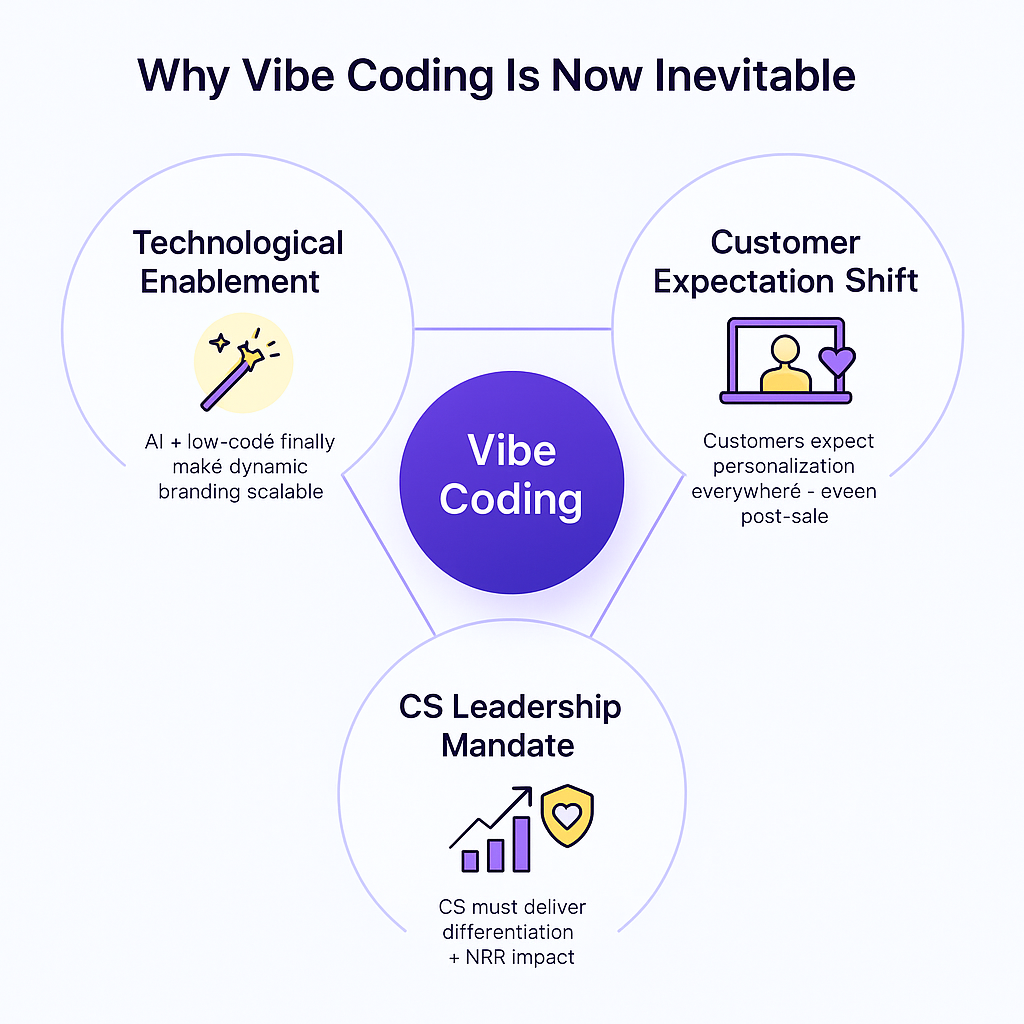
Vibe Coding is the operational convergence of three core components:
1. Design Expresses the Brand
The interface acts as a living, breathing component of the brand system. Every element, from color palette and typography to micro-interactions and language tone, must reinforce the company's identity. The customer feels a sense of familiarity and trust because the experience is unique to the brand they just bought into.
2. Data Drives Personalization
The experience is personalized using real-time data inputs (adoption metrics, health scores, financial data, support history). The content shown, the next steps recommended, and the overall layout are not static; they change based on the customer's immediate context.
3. Intelligence Connects Both in Real Time
AI and intelligence systems are the connective tissue. They ingest the raw data, interpret the customer's current phase (onboarding, renewal, risk), and then instruct the design system to present the appropriate branded experience.
In short: Vibe coding operationalizes emotion by turning brand identity into a dynamic, data-backed utility. The result is a customer experience that feels intentional, trustworthy, and unmistakably on-brand.
Why The Time for Vibe Coding is Now (A Triple Mandate)
Five years ago, building dynamic, branded customer interfaces was prohibitively expensive, requiring months of custom engineering work and constant API maintenance. Today, three converging trends have made Vibe Coding an immediate necessity and a scalable reality:
1. The Technological Enablement: AI and Low-Code Design
Generative AI and advanced data orchestration tools have dramatically lowered the barrier to entry for dynamic interface design.
Decoupled Design: Low-code design builders allow CS Operations teams (not just engineers) to build sophisticated, highly customized interfaces using a drag-and-drop system.
Intelligence Automation: AI assistants can instantly adapt interfaces on the fly, using the same real-time customer data (e.g., product usage, open support tickets) that drives internal CSM playbooks. This makes the interface as intelligent and adaptive as the product itself.
2. The Customer Expectation Shift: The Seamless Journey
Customers today expect hyper-personalization and familiarity across every interaction, not just from the marketing website or the product UI. They engage with platforms where the interface is a reflection of their individual history.
The Post-Sale Dissonance: When the marketing team delivers a unique, personalized buyer journey, but the CS team delivers a generic, templated portal, the customer feels deprioritized. They demand a post-sale experience that is as fluid and branded as the pre-sale experience.
3. The CS Leadership Mandate: Differentiation and Revenue Impact
CS leaders are under intense pressure to move beyond simple retention metrics and prove their function as a growth driver (Net Revenue Retention/NRR). Vibe Coding is the strategic differentiator they need.
Customer Loyalty is Brand Loyalty: By making the customer interface feel unique and branded, companies build emotional loyalty that is impervious to competitors.
Reducing Churn via Transparency: A dynamic, branded interface that transparently shows the customer's real-time value realization reduces friction at renewal and lowers the likelihood of churn stemming from poor communication or confusion.
Customer Success: The Last Frontier for Brand Experience
{{cta-demo2}}
Customer Success is the final major business function where brand and data are typically allowed to live apart. CSMs are forced to manage high-value relationships in tools designed purely for internal operations, creating portals that inform but fail to inspire. This missing ingredient is a design layer that feels like the company itself. This is exactly where Vibe Coding belongs. It transforms the often static, overwhelming customer interface into a living expression of your brand's commitment, dynamically shaped by real-time data, company knowledge, and the strategic guidance of the CSM.
The Tangible Impact on CS Metrics:
Challenge Solved by Vibe CodingMetric ImpactedResultTonal Dissonance & FrictionCSAT / NPSHigher customer affinity, leading to better scores and qualitative feedback.Confused Value PerceptionValue Realization ScoreInterface focuses attention on high-value features, accelerating time-to-value and increasing feature adoption.Renewal InertiaNet Revenue Retention (NRR)Consistent brand messaging and personalized, transparent progress reporting reduces renewal friction and increases willingness to expand.Internal Data HuntingCSM ProductivityCSMs spend less time aggregating data and more time on strategic, relationship-building activities, increasing their portfolio capacity.
EverAfter AI Studio: The Vibe Coding Engine for CS
At EverAfter, we recognized that the future of relationship management requires a platform built for both scale and soul. We built AI Studio specifically to make Vibe Coding an accessible, scalable, and instant reality for Customer Success teams.
Why AI Studio is the Vibe Coding Environment for CS
%201.png)
AI Studio is the embodiment of Vibe Coding because it is the first platform that structurally addresses all three requirements of the framework, Design, Data, and Intelligence, specifically for the post-sale experience.
It Operationalizes Design: AI Studio provides the low-code design tools to instantly translate a static brand guide into a dynamic, code-ready interface that can be deployed across thousands of customer portals. It ensures every visual element, from success plan trackers to resource libraries, is on-brand.
{{cta-demo2}}
It Centralizes Data: The platform serves as the central data orchestrator, pulling live health and adoption metrics from every source (CRM, product logs, support tickets). It uses this unified data to feed the personalization engine.
It Introduces Intelligence: The AI engine interprets the customer's real-time journey status (e.g., Stalled in Onboarding, Ready for Expansion) and instructs the branded interface to change accordingly. It determines which content to show, which CTA to highlight, and which metrics to surface to maintain optimal "vibe" and drive the customer forward.
The Critical Need for a Dedicated Customer Interface
Existing CS solutions are powerful, but they are built primarily for internal operations and reporting. They fail to provide a compelling, branded, two-way digital experience for the customer.
The Customer Interface addresses this by:
- Creating a Single Source of Truth for the Customer: It pulls all relevant information, success plans, health metrics, adoption progress, and upcoming meetings, into one place, preventing customers from having to hunt through emails and separate logins.
- Driving Proactive Behavior: By visualizing progress (or lack thereof) in a highly transparent, engaging, and branded way, the interface encourages customers to self-serve and take actions that drive their own success, reducing reliance on the CSM for routine questions.
- Cementing Partnership Value: It shifts the relationship from vendor-client to strategic partner. The interface becomes the shared cockpit where the customer and CSM view their progress toward common goals, reinforcing the value of the investment every time they log in.
EverAfter AI Studio is the first true Vibe Coding environment for Customer Success, the convergence point where superior design, live data, and strong brand converge to build unparalleled customer loyalty and market differentiation. See how companies like AppsFlyer, Spryker, and Okta are already leveraging EverAfter to transform their customer experience.
VI. Conclusion: The Future Belongs to Data-Backed, Brand-Driven Experiences
The future of Customer Success will not be standardized, static, or templated. It will be designed with intention.
Companies that master Vibe Coding now will build customer relationships that feel human, informed, and unmistakably on-brand. They will not simply deliver success metrics; they will deliver brand experiences powered by data, transforming CS from a cost center into a growth engine. EverAfter AI Studio is the platform where that future starts. Ready to elevate your post-sale experience and bring Vibe Coding to your Customer Success team? Book a demo to see AI Studio in action and transform your customer interfaces.

.png)

.png)


%20(1).png)


.png)
.png)
.png)


.avif)



.png)
.png)


