





TL;DR: After merging EverAfter with Base AI, I learned that CS and CM share the same mission (post-sale growth) but operate with fundamentally different mental models. CS thinks in accounts; CM thinks in people. CS prevents risk; CM amplifies wins. The companies that connect these two functions without collapsing them will define the future of post-sale.
A few weeks into working with Gal Biran, CEO of Base AI, we hit a wall.
We were debating something that seemed simple: what does "customer" actually mean?
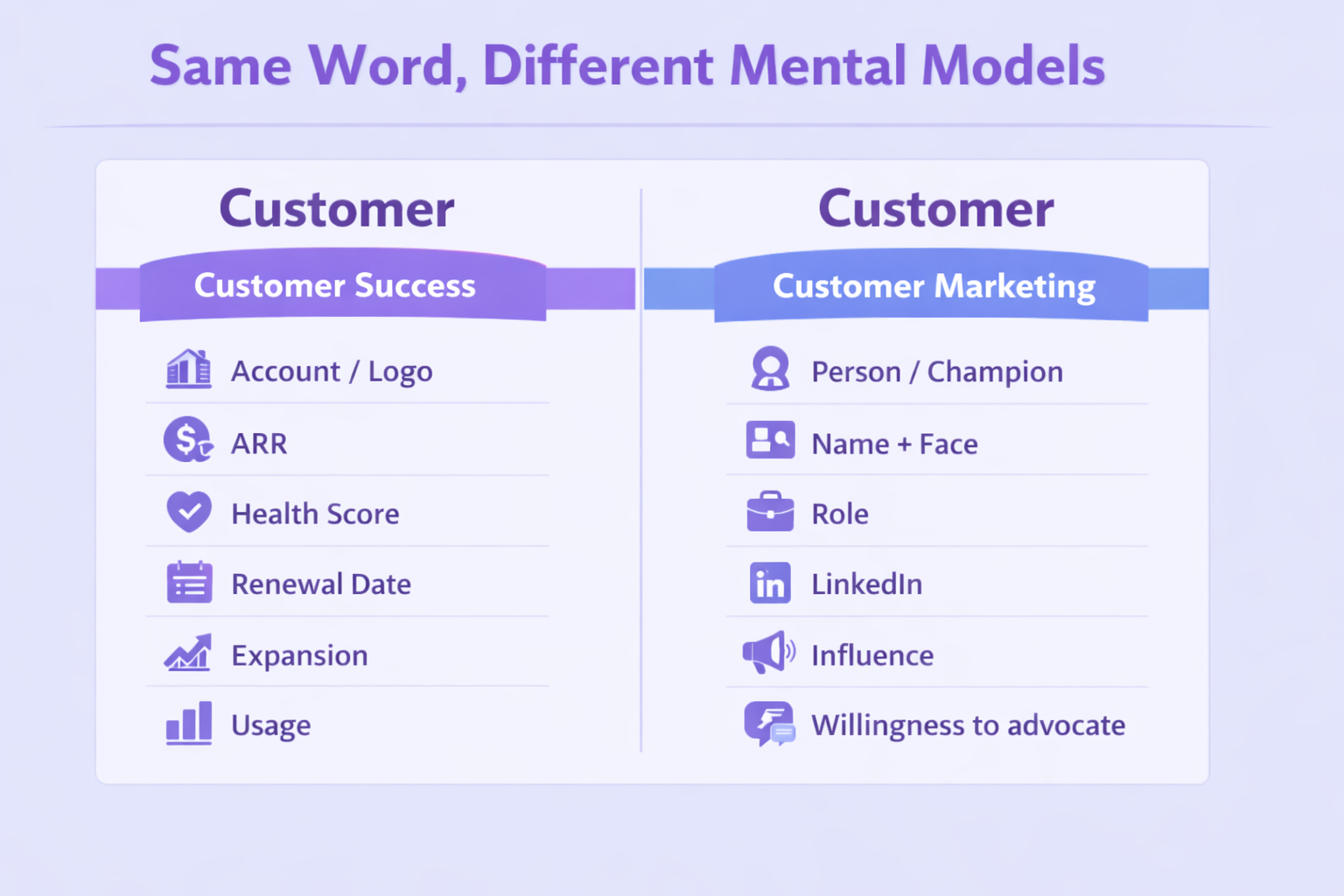
For us at EverAfter, working closely with Customer Success teams, a customer is an account. A logo. A contract with health scores, renewal dates, and expansion potential.
For the customer marketing space, focused on advocacy, referrals,community - a customer is a person. A champion. A speaker. A reviewer. Someone with a name, a LinkedIn profile, and influence.
Same word. Completely different mental models.
That one debate taught me more about Customer Marketing than years of sitting adjacent to it.
Why this matters now
Customer Marketing isn't new. But for most CS leaders, it's still someone else's job. A team in marketing. A Slack channel you're not in.
That's changing.
Retention is everyone's problem now. Advocacy is everyone's goal. CS and CM are colliding whether we planned for it or not.
So I started paying attention. To how Gal thinks. To how his team operates. To where we speak the same language and where we don't.
Here's what I found.
Where CS and CM are the same
Both are post-sale growth engines.
Retention, expansion, advocacy. It all starts after the deal closes. CS knows this. CM knows this. We just describe it differently.
Both translate value into outcomes.
CS proves value through adoption and results. CM proves value through stories and influence. One shows the dashboard. The other tells the story behind it. Same mission.
Both depend on trust.
No trust, no renewal. No trust, no advocacy. Trust is the currency. We just spend it in different places.
Both are voice-of-customer functions.
CS hears it in QBRs. CM hears it in testimonials and reviews. Same signal. Different channel.
Both are cross-functional by nature.
Product, Support, Sales, RevOps. No one owns the customer. Everyone serves them.
Where CS and CM are different
This is where it gets real.
Account vs. contact.
Customer Success is measured on accounts. Usage, risk, renewal. CM obsesses over people. Champions, speakers, references.
This changes everything. How you prioritize. How you measure. Who you build relationships with.
CS asks: how is this account doing?
CM asks: who at this account can we activate?
Both questions matter. But they lead to very different actions.
The numbers tell the story. According to Gainsight research, a typical enterprise CSM manages 10-50 accounts worth $2-5M in ARR. A mid-market CSM? 100-250 accounts. The work is structured around logos, not people.
Customer Marketing flips this. Your best advocate might be a mid-level user at a mid-tier account. Your worst reference might be an exec at your biggest logo. CM has to see past the ARR and find the humans who actually want to talk.
This is why the two functions sometimes clash. CS prioritizes by account value. CM prioritizes by individual willingness. Both are rational. Both can be right.
1:1 vs. 1:many.
CS is built around nuance. Every account has context. Every escalation has history.
CM is built to scale. Repeatable programs. Segments. Campaigns.
CS asks: what does this customer need?
CM asks: what do customers like this need?
Here's the math that makes this real: 52% of B2B companies now have a formal customer advocacy program, up from 39% just a year ago. But those programs typically run with small teams and budgets under $500K. They have to scale.
That means CM can't afford to treat every customer like a snowflake. They build segments, launch campaigns, create repeatable motions. Not because they don't care about individuals, but because that's the only way to create impact at scale without burning out.
CS can afford (and is expected) to go deep. CM has to go wide. Neither approach is better. They're just built for different problems.
Risk prevention vs. growth amplification.
CS detects problems early. Churn signals. Friction. We're trained to save.
CM amplifies wins. Social proof. Community. References. That's the heart of a Customer Advocacy Program.
One stops the bleeding. The other spreads the success.
The data backs this up. Companies with dedicated CS teams see up to 25% higher net revenue retention than those without. That's risk prevention at work.
On the amplification side? Companies that actively use customer references in their sales process see win rates 20-50% higher than deals without them. Word of mouth has been shown to increase marketing effectiveness by up to 54%.
CS protects the base. CM multiplies the upside. You need both.
Team structure.
CS often scales into big orgs. CSMs, Support, Services, Ops.
CM stays lean. Centralized. Fast.
This isn't just an org chart thing. It changes how decisions get made and how quickly things move.
Metrics.
CS: retention, churn, NRR, health scores, time-to-value.
CM: reviews, references, case studies, speakers, pipeline influence.
Until these metrics connect, the teams won't either.
Net revenue retention has become the north star metric for CS. Industry benchmarks hover around 101-109%, with top performers pushing past 120%.
CM metrics are fuzzier. Pipeline influence. Reference requests fulfilled. Reviews generated. Case studies published. These outputs matter, but they're harder to tie directly to revenue.
This creates real tension. CS can point to NRR and say "we drove this." CM often has to tell a more complex attribution story. Until both teams share a common language around customer value, they'll keep operating in parallel instead of together.
What I believe now
These differences aren't a problem. They're a feature.
CS and CM see customers differently because they serve different parts of the same journey. One keeps customers successful. The other turns that success into momentum.
The companies that figure out how to connect these two will define how B2B works with customers going forward. And the infrastructure that makes this connection real is an AI-powered digital customer success platform — one that gives both teams a shared view of the customer, their journey, and the actions that drive growth.
Not merge them. Not collapse them. Connect them.
That's what we're building.

.png)

.png)


%20(1).png)


.png)
.png)
.png)


.avif)

Noa Danon | Founder & CEO, EverAfter
Noa is the Co-Founder & CEO of EverAfter. Noa's rich product-focused background at B2B SaaS organizations working in both corporates and startups. She is focused on creating a game-changer technology that helps customer-facing teams deliver an outstanding customer experience.




.png)
.png)


